Representation
Workforce demographics across entry, management, senior leadership, and board levels.

Flagship Research Initiative
A proposed annual, cross-industry benchmark designed to help Rhode Island employers understand workplace inclusion practices, identify opportunities for improvement, and track progress over time.
Why It Matters
Rhode Island has important research measuring resident well-being and community outcomes. The Belonging Index is designed to fill a different gap: understanding how employers are doing inside their own workplaces.
This is not an awards competition, a public ranking, or a compliance investigation. It is a confidential learning and improvement initiative intended to give participating employers useful evidence without calling out individual organizations.
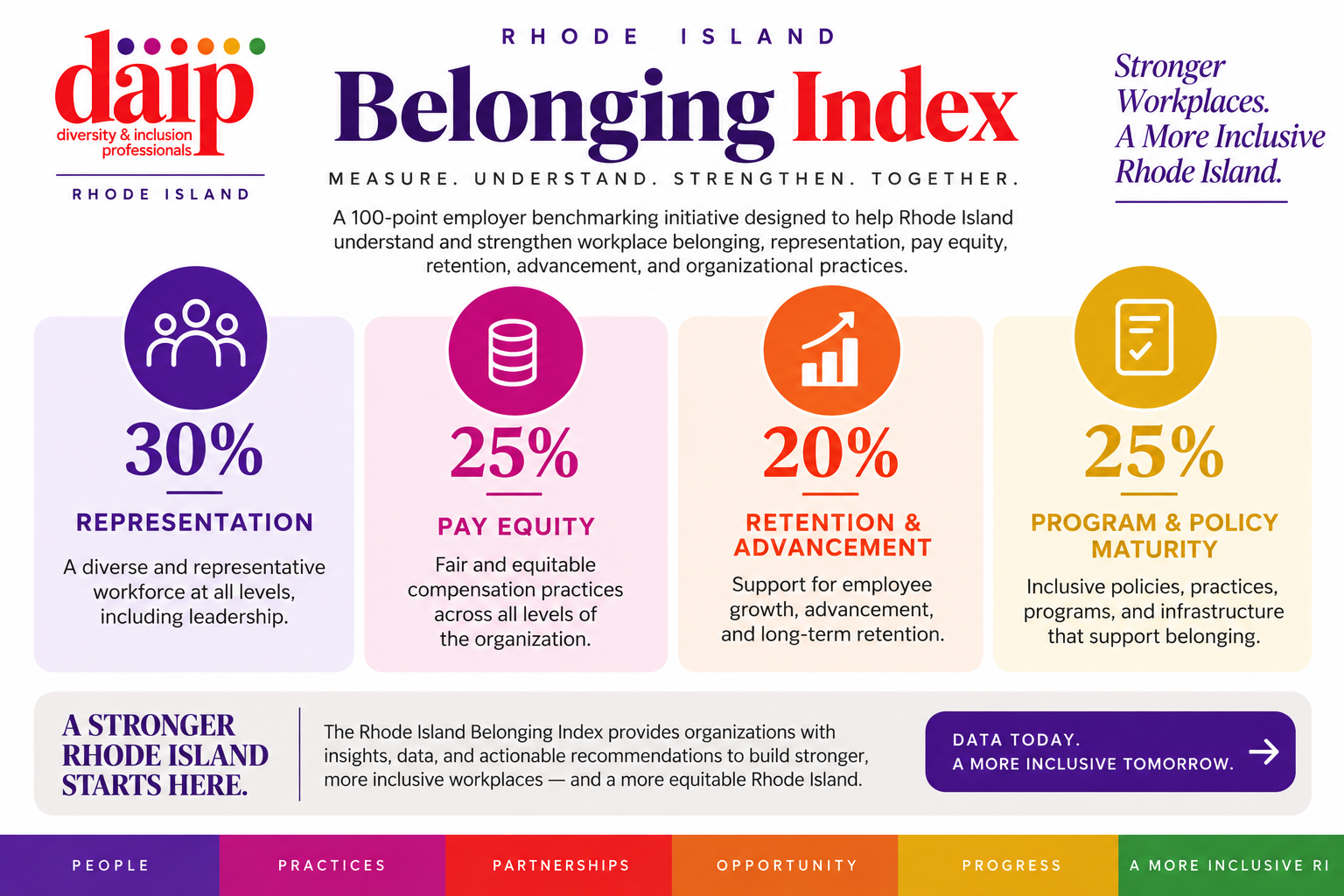
Click or tap the framework to view it full size.
Proposed Framework
These weights are an illustrative starting point. Final definitions, weighting, and validation will be co-designed with an academic research partner and Advisory Council.
Workforce demographics across entry, management, senior leadership, and board levels.
Aggregate pay-gap analysis by demographic group at comparable job levels—not individual salaries.
Aggregate turnover and promotion patterns across demographic groups.
Policies and practices supporting mentorship, leadership pathways, flexibility, accommodation, training, and supplier diversity.
An anonymized belonging pulse survey used as a diagnostic during the pilot.
Data Collection & Confidentiality
HR or People teams submit organization-level information through a secure form. DAIP does not request employee names or individual salary records.
Employers distribute a brief employee survey. Results are returned anonymously and reported only when minimum response thresholds are met.
Available public filings, annual reports, board information, and workforce reports may supplement—not replace—employer submissions.
Each employer receives its own results. Individual scores remain confidential unless the employer provides written permission to share them.
Public findings appear only at a combined or sector level. A sector is reported only when at least three employers protect against identification.
The goal is to understand patterns, support improvement, and strengthen systems—not identify or shame individual employers.
For Participating Employers
A confidential view of strengths, gaps, and opportunities across the measurement framework.
Comparison with aggregate sector peers without revealing another employer's information.
A consistent way to monitor progress and understand where additional attention is needed.
Clear next steps to inform workforce, leadership, workplace culture, and accountability strategies.
Partnership Model
DAIP is seeking an academic research partner and policy, workforce, business, and community collaborators. Potential collaborators include Rhode Island higher education research centers, the Economic Progress Institute, the Latino Policy Institute, the Women's Fund of Rhode Island, Providence Business News, and Rhode Island SHRM. These are prospective collaborators unless and until a formal partnership is announced.
Methodology design, statistical validation, secure data stewardship, analysis, and research support.
Equity expertise, community trust, contextual interpretation, policy relevance, and stakeholder connections.
Employer recruitment, sponsor engagement, statewide visibility, and connection to the Inclusive Workplace community.
Pilot Roadmap
Finalize definitions, privacy rules, instruments, weighting, governance, and reporting standards with research and advisory partners.
Recruit approximately 10–15 employers across banking, insurance, healthcare, higher education, and nonprofit sectors.
Deliver confidential employer scorecards and publish an aggregated report once privacy and sample thresholds are met.
Refine the benchmark annually, track progress, and use findings to inform DAIP programs and policy conversations.

Kevin Matta (he, him, his) is a strategic differentiator, comfortable challenging the status quo, and brings both passion and experience to ensure client success and human engagement with his brilliant ability to make connections.
Kevin’s interest in justice, equity, diversity, and inclusion work developed as he witnessed his parents encounter inequities and injustices while navigating the American healthcare and workplace landscape. His passion for this work continues to be strengthened by the systemic injustices people around the world continue to experience.
Kevin serves as president of DAIP’s board of directors.